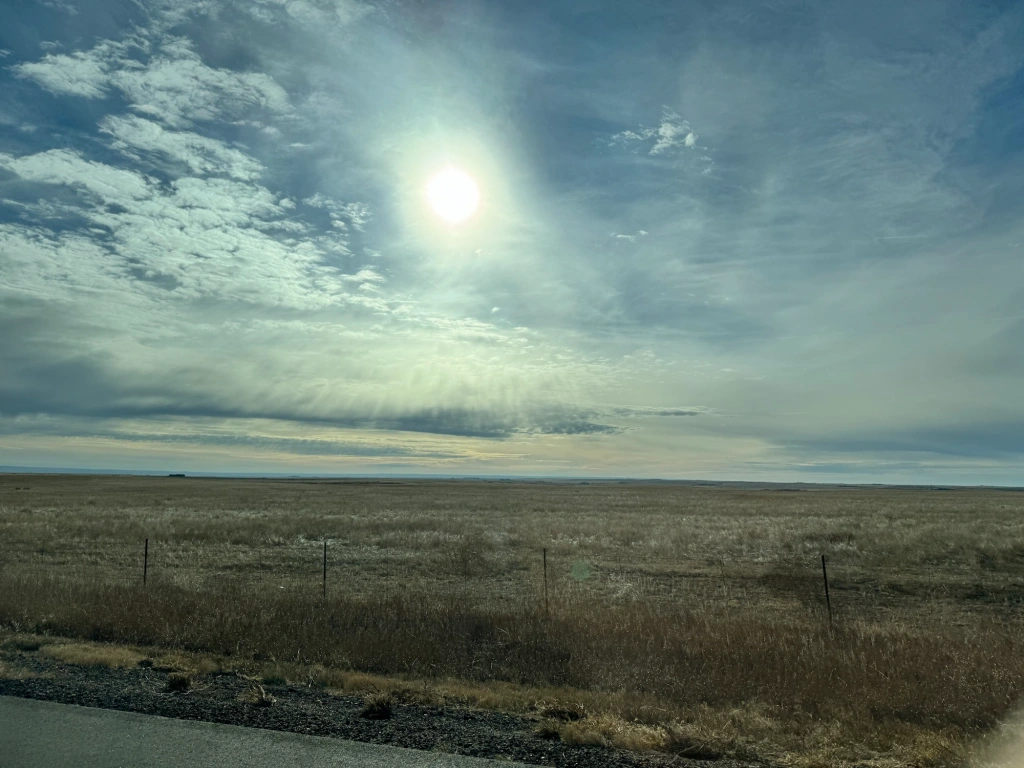
100th Meridian

My friend Jon Travis died last night. I don’t think he’d mind me just blurting it out like that. He wasn’t one to stand much on ceremony. He wasn’t fancy, although he had good taste. We weren’t lifetime friends, but it sure felt like it. I met him through a friend. She brought him to the Music Hall, my old theater, in 1993. He wanted a job and I didn’t have a job to offer. But he kept hanging around. Sometimes he would come even though I couldn’t pay him. Sometimes, I’d have him on a show crew and he’d bust his ass with the rest of us trying to put on a show for small money. Finally, he became my stage manager. It just happened. One day I looked up and he was there at the stage manager’s stand and it was like he was supposed to be there, or like he’d always been there and I just never noticed. We’d had good stage managers before Jon, but Jon brought something special to the job. He didn’t buy trays of cold cuts for performer food; he made fresh sushi and gourmet salads. He didn’t run cheap coffee through our old machine; he brought in a cappuccino machine and handed out frothy espresso drinks. He was grouchy and difficult sometimes too and just when you’d think he was going to flip over something, he’d bust out a killer Ethel Merman impersonation as he was climbing the stairs to the flyfloor to heft sandbags and lead weights to balance out the lights and scenery on the pipes. When Gail and I got married on the Music Hall stage, he stage managed the wedding. He cared about that building. For several years, the place couldn’t have run without him. He needed us, but we needed him more. Or maybe I needed him. He wasn’t afraid to be the “bad” cop when I was the “good” cop for shows. In fact, I think he sort of liked it. Now that he’s gone, I feel as if I still need him.

Other things: I was in his wedding party where him and his wife Cathy asked me to read “Oh, The Places You’ll Go” by Doctor Suess as part of the ceremony. He loved pub rock, especially the Reducers. Jello Biafra once spent the night on his apartment floor. He’d seen hundreds of shows, bands that most people never heard of but who Jon loved. We went to see the Tragically Hip together at least a dozen times. Man, did that guy love the Tragically Hip. I think that was my one big gift to him, turning him on to that band. We played the Hip so often that most normal people would have gone insane. Once, early in our friendship, as we drove back from a late night load out of a Nutcracker in some high school hours away, we listened to the Hip cd “Day for Night” over and over, very loudly. We sang and sang and sang to that album. We analyzed the songs. We somehow connected over that band. Another time, the Hip came to our theater. We were giddy. When the Hip were doing their soundcheck, Jon went into the dressing rooms and took a shower. Later, when we met Canadian Tragically Hip fans at other concerts, Jon loved telling them that he once sang in the shower along with Hip as they soundchecked. It was the little things, really.

Of course, Jon’s gift to me was his warm and true friendship. He was easily annoyed by much, but he never seemed annoyed with or by me. He was always glad to see me and I him. I hadn’t seen him too much over the last few years, but that is normal, I suspect. We both were married and had full lives. We’d been talking quite regularly recently, thanks to facebook. He was a tremendous artist. Here is a link to his art:

http://www.hygienic.org/profile/JonLTravis

As I worried about my writing, Jon would tell me just to write something. He practiced what he preached in his own art. Just make something.

When I worried about my teaching, somehow convinced that what I did wasn’t important, he said: “That’s the difference between what you do now as opposed to what you did at the Music Hall. There, it was instant gratification. You got the audience reaction and you knew the show was good and your performance was validated. But teaching, you never really know. You just have to trust that you are getting through to someone.”

He believed the same thing about art. I have a painting of his over my desk of a still of Robert Mitchum from “Night of the Hunter”. Here is the original still:

Night of the Hunter

Here is Jon’s painting:

Jon's Mitchum

I think I’ll have more to write about this, but tonight I was just feeling his loss. Now that I am typing the images and memories are blurring together. The last time I saw Jon was about four months ago. We went to see the Tragically Hip together in Boston. He became fast friends with a bunch of drunk Canadians. We had to stand the whole time and Jon was tired, but it didn’t stop him from putting his whole body into the music. Perhaps the Hip song that comes to mind for me most right now is titled: 100th Meridian. Towards the end of the song, the singer sing/chants these lines: If I die of vanity/Promise me/Promise me/if they bury me/Some place, I don’t want to be/You’ll dig me up/And transport me/Unceremoniously/Away from/The swollen city-breeze/Garbage-bag trees/Whispers of disease/And acts of enormity/And lower me/Slowly, exactly and properly/ Get Ry Cooder/ To sing my eulogy/ At the hundredth meridian/ Where the great plains begin.

Jon, along with the rest of the Hip crazed crowd would go crazy just about the time the Ry Cooder line pops up… all of us bouncing up and down to the song. It’s a good memory of the man–passionate, a bit crazy, artistic, loving, grouchy, friendly, real. Wherever Jon is, I know he’d want Ry Cooder to sing his eulogy. And I love him for that. And all the other things. I miss him.

Published in: on November 5, 2009 at 9:31 pm Comments (1)

Been gearing up to write. That’s all I know. I’ve been not writing and now that my house renovations are almost done, the words must come back. Last week, I taught a Robert Olen Butler story entitled “Jealous Husband Returns in Form of Parrot” and have been fascinated with Butler ever since. I’m reading his book From Where You Dream. It is basically a series of transcribed lectures he gave to a writing class, I don’t remember at which school. It is fascinating how he describes the writing moment. He says that if you think about writing in a rational, idea-driven fashion, the work will fall short of any artistic goals. Art, he says, is not born of ideas. I’ve been telling my students a version of this for a long time. I tell them not to think when they write, as counter-intuitive as that may feel. I tell them that writing is much more like dreaming than thinking, that the “self” that pays bills and buys food and mows the lawn and prepares taxes is not the same self that can dip into E.M. Forster’s creative state–a place from which a writer will uncover things normally beyond his reach. I’ve fallen into the trap of thinking I had ideas for stories. Especially when I was just beginning–I was always having ideas. Now, I’ve been writing consistently for thirteen years (I really only started writing at thirty) I rarely have ideas. All my early stories were ideas before art. My first novel (horrible, horrible book) was full of ideas and despite occasional bursts of good language, was a failure. My second novel broke the pattern a bit. I wrote two hundred pages on an idea. Then, when I got to page two hundred, I realized that I was going about it all wrong. I cut everything and started over, with no idea where I was going. I still believe in that book. I think I reached a core of honest yearning for my characters. I no longer mourn the fact that it never found a home. I am happy that I wrote it and that it is painful and joyful and concise in its uncovering of grief. My newest manuscript (anyone who has read this blog as seen my writing concerning the work) had no idea at all. It started with water. That was all. I feel that the work was as pure a piece of imagination as I could create. I did not think my way through the book. There are large parts of the book that I barely remember writing. It came in a trance, I suppose, a creative state in which my artistic self surprised my rational, everyday self. I have no clue if anyone will ever publish the book. That’s okay too. I’d love to see it in the world, but if it stays with me, my art, my private adventure, I am satisfied with the outcome. I’m gearing up to write. I do not have an idea. I have an image. That is all. My goal is to figure a way to write toward that image. Nothing more.

Published in: on October 23, 2009 at 8:55 pm Comments (1)

Time Away and Gearing Up

Keeping a blog is harder than I ever expected. My life off the screen has been hectic. We’ve been renovating the last two rooms of our old farmhouse in preparation for my father-in-law to join us. The rooms were once the ugliest rooms in our house. And considering the state of the house when we bought it, that’s saying something. Now, the rooms are two of the most beautiful. With the rooms nearly done, I hope to bring myself back to speed in this small descriptive account of my writing life. I suspect we will still be inordinately busy, but I hope to devote my newly freed up “building/renovating” time to my writing life. I haven’t written anything since I finished the manuscript of The Improbable Colony at the end of May. I’ve been sending the book on the rounds with agents that I think might be a good fit, but have had no success interesting anyone as of yet. Still, the best medicine for the apathetic response to one’s writing is to simply get back to doing more writing. So this is an attempt to kickstart that process. Anyone else trying to sell a book with little success?

Published in: on October 16, 2009 at 7:14 am Leave a Comment

The Story of a Saw

I’ve been absent from this blog for some time now. When I started the blog, I didn’t think writing a bit each week would be so hard. But as it turns out, I find the process difficult because it takes me away from exactly what I’m supposed to be blogging about. Namely: my life as a fiction writer. I started the blog as a way to “report” to the New Hampshire community after being awarded the New Hampshire Individual Artist Fellowship, and figured I come every week and update my massive readership on the novel I’ve been working on and which helped me secure the fellowship. A little jot here, another there, voila, I’m an official blogger. The problem is, I ran out of things to say about writing fiction that didn’t somehow detract from my ability to write fiction. During the semester, my writing life is pretty diminished. Between work, grading, home renovations, family, and the daily life of chores, when I sat down to write, I needed to focus on my manuscript. Hearing about that slog gets boring pretty quick. It goes like this: I worked on my book again today. I spent several hours fixing my crappy sentences and then had to overhaul an entire page for continuity problems. Then, I realized I’d accidently called the same character by two names. The work was tough, but in the end, I made the story stronger. It wasn’t exactly fun, it was rewarding in a strange sort of way. Reading that type of description of the writing life would be less than enlightening. Now that school is over, I hope to say more, report more, and shed more light on why I do what I do. But first, this:


My Miller's Falls reciprocating saw, broken beyond repair.

My Miller's Falls reciprocating saw, broken beyond repair.

Yes, that is a reciprocating saw, more commonly referred to as a “saw’s all,” which is like calling all petroleum jelly “vaseline.” And yes that saw is flat out busted. In many ways, this saw has been a bigger part of my life than writing. It’s sad to say, but true, especially over the last few years as we’ve renovated our old farmhouse. Last week, I was busy cutting out some old, rotted supports from the last unrenovated section of the house and the saw got stuck somehow in a beam that didn’t look as though it ought to be that tough. A reciprocating saw works like a regular handsaw, back and forth rather than spinning like a skill saw, except that it is driven by a powerful mini-motor. The saw got stuck, as it has hundreds of times, and I applied pressure and the blade jammed more and the saw wrenched around in my hands something fierce. The next thing I knew, I was holding the back end of the saw, live wires exposed, and the body of the saw was still lodged firmly in the house. It seems that our home was fighting back. I unplugged the saw and pried the metal casing away from the source of its trouble. The blade had got so hot that it fuzed with a piece of wood and was quite hard to dislodge. 

So what? It’s just a saw right? Who cares? Isn’t this a blog about writing? Not today. Today, it is a story, or perhaps an obituary. I bought that saw in 1993 from Peavey Hardware, in Portsmouth New Hampshire–a hardware store for two hundred years. They had all sorts of hidden alcoves and whole floors of storage. They were small town, personal. They wrote all receipts by hand. They had a shelf next to the cash register they kept stocked with tools pulled from some deep dark corner. I was working at the Music Hall in Portsmouth back then (I still called myself a writer, but I never wrote anything) and we were putting a new roof vent on the stagehouse. The guy with the “saw’s all” didn’t show up and we needed one. I wasn’t making much money then, but I decided to bite the bullet and go to Peaveys, where I bought this saw. Miller’s Falls was a good brand, but they’d been out of business for years. I paid $149.00 for the saw and it very quickly became my favorite tool. I sound a bit sentimental about it, true enough, but why not? It was good quality, American made, reliable, bought from a store that no longer exists (and a type of store that no longer exists, either) and served me well. I used that saw like no other tool. I certainly got my money’s worth. 

About five years ago, we bought this old wreck of a farmhouse and set to work fixing it. Not a day went by that I didn’t use that saw for something. So, when I felt it come apart in my hands, it was like losing an old friend. So, that’s what this writer does when he’s not writing. He’s sawing stuff. That’s the real life of this writer. I used to have this glamorous idea of the writer’s life. I’d have a great desk. I’d sit there with a cup of coffee and marvel at how wonderful my writing life was and how easy the words flowed and how rewarding my work was and how important. The truth of the matter is far more mundane and much more real than that fantasy. I’m a father, a husband, a teacher. I struggle with making writing a centerpiece of my life, but I keep trying. It’s taken me years longer to find my writing self than I ever would have thought. I’ll be forty three this summer and have yet to publish anything beyond some short stories. I’ve written nothing, absolutely nothing as powerful as I believe I will, and yet I keep trying.

Over the past few years, I’ve been working on this manuscript and feel that I’m coming to an endpoint. It is good, I think. And yet the thing that mattered the most to me on this day was putting a picture of a saw on a webpage. It’s one of those concrete details that I tell my students they need so desperately in their fiction, a link to a character’s life. My broken Miller’s Falls reciprocating saw says more about me than most of my other possessions. I’m going to secure the saw in it’s original metal box and hang it near my desk next to my dear friend Jon Travis’s awesome painting of Robert Mitchum. Mitchum and Miller, inspiring this writer, drawing him back to the written work.

Published in: on June 4, 2009 at 10:48 pm Leave a Comment

Oh, the process…

It has been a long time since I’ve posted here. I began my blog with the best of intentions. I would write every Friday as a report to the New Hampshire community on my State Council Fellowship. I would write about my creative process. I just realized that it has been over a month since I returned to this site. What in the world could be keeping me away so long? It hasn’t been because I’ve not wanted to write, but that my writing energies have been directed toward the manuscript of my novel, and not the “process” of finding reporting on my writing life. Process is a funny word with writers. We all have a process. When people go to see writers read, they ask, “What is your writing process?” When we talk to students about writing, we say that it is, “process” oriented. When we sit down to write, we work with drafts, and when we are struggling, we say it is part of the “process.” But there is no way to adequately define the process. When I say that my writing is process oriented, I think that is just code for “I don’t really know how I get from one place to another. I don’t really know how one draft is built on the bones of the last draft. I don’t really know how I suddenly have three hundred and thirty pages of a messy, first draft of a novel.”

Process. How’d I get from point A to point B? Process. How am I going to clean up the messy manuscript I’ve been working on for nearly four years? Process

In my last post, I described how I came to set my characters onto their raft in the middle of the a flooded world. My apocalyptic event. My Great Flood. Two people. Adam and Eve. Well, that’s the chapter that I’ve been working on for the last week. Part One. In fact, the main reason for my delayed blogging routine is directly related to the work I’ve been putting into the novel. After writing the last quarter of the manuscript long hand, I translated my writing to the computer and printed out the pages. It was a nice moment to see the pages stack up in the printer, but only a moment. After I saw the paper sitting there, warm from the printer cartridges, it hit me how much work was ahead of me. I’m not one for believing my first drafts are any good. For some people, maybe. For me, the first draft is far, far from finished. Like many writers, I’ve felt the draw of the energetic nascent draft. There is a power to the new creation, but not a lasting power. Plus, I think my eyes lie to my brain. They tell me sentences are sparkling, images clear and orderly, characters believable and fully developed, even when those things are far from the truth. Revision, the process, is all about slowing down. I’m forty-two now, and I think I might be finally getting that lesson burned into my consciousness. 

So I printed out the manuscript and read through the pages. Will it hold together? I don’t know. I have to trust the process. I always tell my students to risk something when they are writing. What should we risk? they often ask. Risk is taken on a per-writer basis, I answer. There is no one way to risk. Some writers might write something embarrassing about their families. Or themselves. They might write something honest that they promised a dying loved one they would never write. They might write mean, or gentle. They might write toward God, or away. They might decide to risk point of view, tell a story from across the gender or age divide. Or they might drop a reader down a rabbit hole and trust that the reader will follow. My manuscript is of the “rabbit hole” variety. I hope readers will follow. So, what about part one,  the part I’ve been working on?

I couldn’t believe how horrible it was. No, seriously. I teach writing, after all. I should be able to tell a story with some degree of proficiency. In the first part, thirty six pages, give or take, I stumbled across every writing problem I’ve ever struggled with my entire life. This is process. I’d like to think I’d grow into a more able, organic form of story telling, but I have not grown. If this work ever sees it through to the light of day, it will be because of work, plain and simple. Process. In the first thirty six pages, I used the word “was” one hundred sixty four times. I used the word “up” fifty eight times. I actually wrote this sentence: “He looked up at the sky.” This, to me, seems like writing 101. I saw the phrase “up at the sky” and laughed. What other direction would a person look to see the sky? There’s only one way, jack, and it’s up. These are the sorts of sentences I have to work against. Process. Now, I’d like to believe that part one of my manuscript is smoother. In fact, it’s pretty concise, shorn of any excess. I cut away all those sentences that sounded good for the sake of sounding good. I got rid of needless chatter and noise. I now only use the word “was” nine times. I refined what I thought was already refined. How did I do all this? Work. Work. Work. Avoided blogging. Stayed up way too late. Got up way too early. That’s why I’ve been away from this little web-thingy. I’ll try to do better. But I can’t make any promises. I’ve refined the first part of the book now. The shortest part. I only have three, maybe four more sections to go. Next time, I’ll be writing about part two. My two character from part one will be long gone. I’ll be about two hundred generations into the story, nearly two thousand years distant. How am I going to get there? Process

Published in: on March 20, 2009 at 10:26 pm Comments (2)

Story of a Manuscript

Last week I began telling the story of the manuscript on which I’m working. I said that it all started with water. That’s sort of true, but it really begins even further back. In 1999 I took a poetry workshop with Mekeel McBride as one of my last classes as an M.A. candidate at the University of New Hampshire. As part of that class, we had to read books by contemporary poets and write “homage” poems in the style of, or inspired by the reading. It was a great learning tool; it allowed us to try out different forms and to reach outside our already somewhat ridged writing styles. The poet that had the greatest effect on me was Russell Edson. We read a collection of his work entitled The Tunnel and the experience of reading the poems certainly felt reminiscent of moving into a darkness. At first, I didn’t like his often bizarre, surrealist prose poems. I couldn’t tell what it was I was meant to see in his elliptical sentences stocked with gorillas, taxis that turned into walls of butterflies, and men who become stones. But I trusted the teacher; she wouldn’t have pointlessly assigned Edson.

The Tunnel

The Tunnel

By the middle of the collection, I began to enjoy entering Edson-ville. His nightmarishly conceived little worlds grew increasingly soothing, and entry into his vast imagination proved a worthwhile exploration not only of the shape of words and sounds, but also of imagination and perception of our own culture and civilization. When it came time to write my homage, I was forced to look at ordinary things in new ways, to see the fantastic in the everyday. For me, it all came down to numbers. My poem (I am a serviceable poet at best, so I won’t be sharing the poem here) attempted to recreate a society that counted everything. In its first draft, it seemed a terrifying place to imagine—fascistically organized. But the more I wrote, the less terrifying it seemed. Indeed, the inhabitants of my poem took comfort in their counting and were only undone by the wind, which they could find no way to classify or codify. It became a dark utopia, one that I enjoyed pondering.

I enjoyed thinking about it so much that I wrote a short story entitled “17 Historical Documents” that chronicled this civilization in more detail. It was fun to write and to think about and for a long time I thought that would be the end of the story. I tried to interest a few literary reviews in the work, but never had any luck. The society of numerologists was conceptually fun. I think, however, that it was missing a key ingredient to make it a successful short story: context. I think people who read the story thought, “Well, that is a strange land…I wonder how they got that way.” I suppose I wondered how they got that way, too. At the time I was writing the story, I was writing my first novel, and that occupied most of my writing and revising life. After several years of work and rejection on that book (understandable rejection, mind you—the book just wasn’t that good), I returned to short stories, but my attention had been drawn back to realism and away from fantastical stories. “17 Historical Documents” languished.

I’ll fast forward a bit through my next bout of novel writing. I wrote Ghost Light as I worked on my MFA at Bennington College. I wrote a few stories there as well, but the novel took precedence. In December of 2004, the Asian Tsunami struck most of the countries that border the Indian Ocean. The destruction was horrific. I had two friends in Thailand at the time, and they were near some of the worst devastation. Perhaps because of the news coverage, or because the fate of my friends was uncertain, or because of my common bond to humanity and the sinking feeling of helplessness and hopelessness that evolves around natural disasters far away, I began thinking much of water. I didn’t think at the time: “I know, I’ll write a story about the Tsunami!” I never seem to know exactly what I’ll be writing about. The creative mystery isn’t something I normally dissect, but looking back on it now, it is easy to see that I began thinking in terms of a great, global flooding—a noveau forty days and nights—and apocalyptic destruction. At the same time, I was reading Walt Whitman, and it is nearly impossible to remain apocalyptic while reading Whitman. There’s a line in “Song of Myself” that reads: “All goes onward and outward, nothing collapses.” Whitman is talking about death there, but it really fits about every situation. So my thoughts of the apocalypse were tempered by the thought that nothing collapses. It wasn’t exactly optimistic, but it wasn’t sheer dread, either.

In January of 2004, I went to Bennington for my bi-yearly MFA residency. It was a bitterly cold ten days in Vermont. Although the residencies weren’t really geared toward allowing any writing time, I forced myself to spend a bit of time with my work during the morning hours, before the day of lectures and workshops began. Not really wanting to work on my novel, I went into town and bought myself a nice blank notebook at the local bookstore in hopes that it would spark some new stories (new notebooks are such beacons of hope!). And then, with the thoughts of Whitman and the Tsunami and Noah and Floods and Beginnings and Endings floating in my head, I wrote. There, in my tiny little dorm room on the Bennington College campus, I set a man down on a raft. A pretty modest beginning for a novel I suspect, and not the first nor the last book that will start with a man on a raft. Then, as he was floating, he saw a woman floating in the distance. Endings. Beginnings. Man. Woman. Adam. Eve. Creation. All going onward and outward, refusing to collapse. Suddenly, without even meaning to, I’d begun a new novel. It would be nearly five years before I found my way to a finished manuscript.

raft

How I got from floating people to my dark-utopian-number-obsessed society is another story, for another post. 

Published in: on February 20, 2009 at 5:32 pm Comments (1)

Writing Thoughts for the Week (using the popular Facebook “25” format):

1. Transcribing longhand to the computer is tougher than one might expect. 

2. I received five rejections in the last week, four on one day.

3. I don’t believe that all literary reviews treat all submissions the same.

4. Several of my rejections came mere days after sending out the story, which I find fishy.

5. Those who staff the literary reviews and journals have a tough job, admittedly.

6. In my fiction class this week, we discussed Raymond Carver’s beautiful short story, “A Small Good Thing.” My students had thoughtful reactions to the work. Next week, we are reading Joyce Carol Oates. If they thought Carver was dark, wait till they walk into the story-world of “Where Are You Going, Where Have You Been.”

7. I’m have about thirty-five more pages of my longhand manuscript to transcribe before I can say I have a typed first draft of the novel on which I’ve been working.

8. There are four parts to the novel. The first three are fairly “clean”—they need work, but they are readable and have little by way of continuity issues.

9. Part four needs lots and lots of heavy lifting. It’s taken me so long to write this section, that the opening feels mightily disconnected from the closing. All part of the process.

10. Once I clean up the fourth part, attach it to the first three, I will have something workable.

11. Once all four parts are together, a new round of serious revisions will be in order. This novel depends of interlocking images and themes.

12. I’ll be reading the first eight pages of this manuscript next month at River Run Bookstore. For more information about the reading, please check the “News” section of my site.

13. I am now reading The Guermantes Way, volume three of Marcel Proust’s massive novel, In Search of Lost Time. Although it is tough reading—slow reading—reading that requires a lot of patience—I am drawn to it and have vowed to finish the novel. There is no other author that I can think of that can so fully explore the smallest moments, who can so imbue the insignificant with purpose. In fact, I don’t think there are any really insignificant moments in Proust, not so far.

14. I’ve struggled to write this week—though I have written much. I’ve been in transcription mode and it’s hard to convince myself that I am writing. But my story is growing, so I must be doing something right….

15. It is very difficult to let story rejections go. All I can do it send the stories out again. All I can do is present myself at the table and believe that my best writing is ahead of me, not behind me. I talk about this Walt Whitman quote all the time: “All goes onward and outward, nothing collapses.” He is talking about death, but it applies to nearly everything. Everything is extending forward, never backward. It is easy to forget how much effort the writing life requires. It is hard to remember that I must move forward, and that persistence is key.

16. Next week, my daughter turns ten. Tonight, we are going to the town father/daughter dance. I’ve been reading to her class, and next week I’ll begin doing writing exercises.

17. I’ve just found out that I won’t be teaching a fiction class this summer. They decided against offering the class. That is a paycheck that I will miss. But, on the other hand, I will have more time to write, to work on the house, to do silly summer things with Grace, to watch the Tour de France, to read, to take advantage of my non-tenure track position. I don’t have security, and little hope for advancement, but I do get crazy vacation months. I think I can have a polished version of my novel by the end of July.

18. Once, years ago, an agent believed in my first novel enough to take me on as a client. Although she couldn’t find a buyer (Thankfully! The novel is horrible…) and we parted ways, she is willing to look at the new book, once I have a polished draft.

19. My goal is to finish this book, get it to this agent, and see what happens. The novel is strange enough that I think someone might be interested.

20. I know what you are thinking: Clark, the first chapter of this novel is what won you the artist’s fellowship… what in the world is it about?

21. Well, I can’t really tell you…other than to say that it takes place over six thousand years and is concerned with humankind’s renaissance.

22. Is it science fiction?

23. I wouldn’t call it that…but I don’t mind the label. I think of it more as creation myth. Or fabulistic story-telling.

24. Oooo… tell us more…

25. It all started with water….(to be continued next week). 


Published in: on February 7, 2009 at 1:51 pm Comments (1)

Weights Lifted, Weights Lowered

First,  a bit of business. I’ve been telling people that I’ve started a website as a way to report to the New Hampshire community on the Artist’s Fellowship I was awarded. I tell them that I’m doing my best to chronicle my writing life, the creative process, and to reveal a bit of the inner workings of a regular, fiction writing Joe in the midst of creating. That’s not the problem. The problem is that people then ask me if I’ve started a “blog.” And I reluctantly have to admit that yes, I have started a blog. Then I feel the need to quality that statement with a quick acknowledgement that the word “blog” is an ugly, flat, toad-like word (and I mean no disrespect to actual toads, whom I cherish with all my amphibian-loving heart). Yes, I say, I am blogging, but I hate the word and wish we could call them something else. There’s an old Simpson’s episode in which Lisa says, “A rose by any other name would swell as sweet…” and Bart says, “Not if you called ‘em stench-blossoms.” And that’s what the word blog is to me. A stench-blossom. How did we get locked into using such a utilitarian word to describe the sheer explosion of creativity that the World Wide InterWeb affords? Creative people who never knew they were creative are now online writing, posting photos, diving deeply into the creative state (you know, the state that E.M. Forster says will allow an artist to “draw up something normally beyond his reach.”) and all we can come up with is a condensation of Web-log? Well, I suppose I have to be the change I seek… so I pledge to do my best to usher in a new word for blogging. For now, I propose Zapping. Why? Because it’s snappy. It somehow relates to the speed of the InterWeb’s informative flow, so I’m going to go with it. To the right of the weekly post, you will see a new link section entitled Zaproll. There, I will link this blog…er… I mean Zap, to other Zappers out there. Will you help me Zap a more creative term into existence? And if you have a better suggestion, I’m open for discussion on the subject. 

Now, on with the regularly scheduled blog…I mean… Zap. This week was a strange week for me as a writer. I’m back to teaching, so my energies are spread thinner. It is easy to feel the surge of the creative state when one is on break from class, but harder to sustain when class plans beckon, and student papers loom. Still, I’m grateful for my job. Two weeks ago, I saw a crew of cold, presumably grumpy, workers on a roof in bitter cold weather, tearing off the old shingles, and applying new. They had to shovel the snow off the roof first. When I think of that job, and then ponder my job, I know I have nothing to complain about. It’s been so cold here that I’ve not even been working on the renovations of my house. Of course, last week, I spend a good deal of time fighting the ice dam on my roof, and then addressing the heat loss problem, but still, when I go to work, I am in a relatively warm office, and talk to good students with varying degrees of enthusiasm for the courses I teach. And then there were family concerns, service work, pets to take to the vet…blah, blah, blah. The daily life of chores shocks me out of the creative cosmos and into reality constantly. I’ve allowed it to take me away from writing for months at a time because when the important stuff of life calls, what chance does writing fiction have? What chance should it have? Indeed, in an economy like ours, at this point in time, why should I be practicing the craft of fiction in the first place? Again, these are thoughts that swallow many writers and drive them from the page. I don’t have the answers necessarily, but I do know that when I am reading a good, moving piece of fiction, I am enriched by the experience differently than I am by hard physical labor, or by teaching, or by viewing a painting, or listening to carefully crafted music. The work of the fiction writer does not provide easily quantifiable results. John Gardner once wrote, in his book, “On Becoming a Novelist” that writing is like a yoga, or practice, and that the benefits are mostly spiritual in nature (not monetary) and that for those truly called to the profession, those results are enough. And for me, the practice of fiction this week, was powerful. As I noted in another post, I’ve been completing a novel manuscript longhand. On Tuesday, early in the day, before I went to school, I came to the end of the story. I felt it in my fingers as I started writing that day, felt it in my palm, the way the pen nestled there. I knew that I was coming to the end, and that if I focused, if I was able to shut out the noise of my head telling me that what I was doing wouldn’t amount to much, that what I was doing wasn’t work, that what I was doing was a massive waste of time, that I could bring my story to a close within a few pages. And since I was at my table, since the pen was in my hand, and my daily life of chores was cast aside for just a few hours, the muse did visit, and I did find my way to the last sentence. Of course, this is only a first draft, and first drafts for me are miles away from final drafts, but I felt the weight of drafting lift—the sheer imaginative jolt of filling up blank pages—and the weight of revision descend. Since then, I’ve been translating my writing into the computer. All week, the work of fiction has sustained me even though life goes on around me and my responsibilities to my family and my friends and my job are unchanged. I make the time to be at the table, and the energy of the creative state makes time for me. The first draft is done. Now, it is time to begin.

Published in: on January 31, 2009 at 10:42 pm Comments (2)

Foundation

Our house began as a one room building, perhaps a tenant farmer dwelling or a storage shed on the back forty. By the time we purchased the property, the house rambled like a good old farmhouse should. There were many structural problems. It seemed that the entire place was mere moments from falling down. Every wall, every sill, every pipe, every wire—trouble. Only the floors and foundation seemed sturdy. The foundation is made of massive fieldstones and slabs of granite hauled into place by teams of horses.

fieldstone and granite

We bought the house in March of 2005, during my last semester at Bennington College, where I was working on my MFA. Though warned about the quantity of work, we were completely overwhelmed by the task. Really, nothing could have prepared us. Nor, do I suppose, could anything have deterred us. One day, as I was down on my knees pulling plaster and lathe from studs, I discovered a stretch of horrible termite damage. This was nothing new. The house had been chewed on by all sorts of fantastic bugs and rodents. But on this day, the sight of more distress caused me to panic. How could we renovate this entire house when every inch needed attention? I felt massively under-qualified for the task: a pretender, a phony, a fraud. And yet we’d already gone too far to turn back. What else was there to do but move forward? I could only do the work in front of me in the best way I could. Chop wood, carry water—as the saying goes. That panicky moment was a turning point. Whenever I felt hopeless about the house’s condition, I’d go down into the basement to look at the old stones, run my hands over their sheer immovable bulk.

A similar chronology occurred in my writing life—which one might say began as a one room structure: Yes! I want to be a writer! As I got older, read and studied more, I found that the original “room” or desire had grown complicated and unwieldy. To be a writer, one had to write. But to call oneself a writer, one didn’t have to do anything. I could scribble a few words in a notebook, or read lofty novels that dealt with the pain of existence, but I certainly didn’t have prove that I was a writer. Then, as I was approaching thirty, I had a panicky “oh, no…this is too much work” moment in which I realized that my desire to write had become a vague longing. So, I made a decision to try an earnest practice of the craft.

I spent my thirties learning about stories, both reading and writing. My writing was published in good reviews and journals. I wrote two novels (one, supremely bad, is now hidden away, and another, pretty decent, is in limbo). I earned two graduate degrees. We started a family and bought our houses. As a writer, I still felt massively under-qualified for the task: a pretender, a phony, a fraud. Sure, a few stories here and there, but what does that mean? Where’s the fame? Where’s the novel contract? Where’s my table at the Pulitzer Party with Norman Mailer bugging the waiter for some decent scotch? Where’s my Oprah interview?

These are the sorts of questions that kill writers. I let them in the door. I swam around with them, lamented that I hadn’t become the writer I imagined. Perhaps most devastatingly, I stopped writing. I’d been working on a third novel, a risky tale of human renaissance that took place over nearly eight thousand years, but I’d stalled. I worried more about not writing than actually writing. But I’d already come too far. What else was there to do but move forward? In July of 2008 I was notified that I’d been awarded the Individual Artist’s Fellowship. The fellowship was more than mere “recognition.” It was cause to reassess my writing life, to look over what I’d been doing, to see if there was something salvageable—to see if there was a foundation.

Pen and paper

This past December, I made a big change. To break the cycle of “not writing,” I removed the computer from the desk and took out a notebook and pen and I got back to work, writing the last section of my novel longhand. I’ve never written fiction longhand. Even at a young age, I typed. Now, as I renovate the last section of the book, and work toward a complete picture, I feel the words in my fingers, pressing against my palms. Of course, the writing is rough and the going slow, but I am determined to work carefully and diligently, as I’ve tried to do in my home, from the foundation up, until the structure is as sound as the old fieldstones supporting the weight of it all.


Published in: on January 24, 2009 at 1:01 am Comments (2)

Beginning Work

The weather today reminds me of the day that we came to look at our house. It was zero degrees outside and the house had been empty for two years and it was zero degrees inside too. But still, something about the wrecked, creaky old building resonated with us. We walked from the basement to the attic, feet freezing, looking at all the damage and all the potential. Of course, we didn’t know the extent of the damage or have any idea of how distant that potential really was. Maybe our brains were clouded by the cold. Or maybe it was just a “right place right time” type of thing. Whatever the case, we bought the house and got to work.

Nearly four years later,  it is a few degrees warmer outside and about sixty five degrees warmer inside. I’m in the office sitting at a writing desk that overlooks the road, the old oak, and the white plank fence. The floor in here bears the marks of working people–chisel marks on the floor, rough cut boards, divots and saw marks–as does the rest of the house. The people who built this house were not contractors. They were most likely farmers, or hired hands, and they built the house in sections, from one room to the next, and incorporated other buildings under its roof and wasted little, pulling boards from other structures where they could . Last week, I uncovered a twenty four inch wide, one inch thick, hand cut barn board from the last room to be renovated. The men cut these planks using a pit saw–literally what it sounds like: they dug a pit and one man stood in the pit and one man stood above. They shared ends of a very long, sturdy saw and hand ripped each massive trunk into usable boards. Hard work, no matter where you stood. The whole house bears witness to labor of one kind or another. In the cellar is an old canning room and a cistern for storing water. The floor joists still have the bark from the trees. The ceiling beams in the living room were hand cut with hatchets and awls. We’ve added our own labors to the mix. The walls here are used to the sounds of heavy lifting. 


This section of barn board is 24" wide, 1" thick.... from one big old tree.

This section of barn board is 24" wide, 1" thick.... from one big old tree.


Although it doesn’t have the sheer back-breaking quality  of  working a pit saw, I’d have to say that my life as a writer is all about heavy lifting. I’ve never been the sort of writer who found words easily accessible. There is always the daunting process akin to digging the pit and climbing into the hole and working the bottom of the saw in hopes of crafting a usable section of lumber. Many of my students are dismayed to hear that after so long practicing the craft that the process grows no easier. I’m not sure they like to hear me say: It’s all about the work. You really have to get in there and get your hands dirty. There is no acceptable shortcut. Not to those authentically called to the profession. So I feel at home now when I write in this house. When I’m not renovating the next room, I’m renovating my fiction. In fact, it is in the renovation that I find fiction. Without the hard labor, it is simply prose, without attachment to imagination. I certainly wish the writing was easier for me, that I could be one of those prolific writers that seem to easily glide along the current, but I have proven to myself that it is not so and most likely never will be. I have to force myself to sit at the table and write past each failed sentence until I find the path to the right story. 

Recently, I was awarded an Individual Artist’s Fellowship by the New Hampshire State Council on the Arts. Each year they recognize five artists from the state and award them for their efforts. This year, I was so honored. As a requirement for the Fellowship, I’m required to offer a report to the New Hampshire Community, and this site, which I’m titling “Work,” will serve as my report. I will be coming here every week or so, and reporting to my community about my activities as a writer. Although I don’t want to pick apart the artistic process to try and discover the source of its mystery, I will comment on the work as it appears before me. Although I won’t give blow by blow accounts of the novel I am writing, I will attempt to peel back the covers a bit, to perhaps show a non-writing audience (or a writing audience for that matter) what is at stake as I try to access what E.M. Forster called the “creative state.” In that state, Forster wrote, a writer can call up something “normally beyond his reach.” I’ve always found that creative state illusive and a bit tricky to pin down. Perhaps by focusing on the nuts and bolts of the work, the heavy job of lifting that I am called to do on each page, I will find the door into my creative self more open upon approach. 

I look forward to sharing this report with my community. I would like, at the very start, to thank the very wonderful people at the New Hampshire Council on the Arts, and the entire New Hampshire State Government for their support of a broad range of artistic endeavors, and for their specific recognition of my work. Until next time…


Published in: on January 16, 2009 at 6:32 am Comments (1)